🇩🇪Dedicated 4G/5G Mobile Egress in Germany for Agent Fleets
Provision carrier-assigned German IPs from Deutsche Telekom, Vodafone, and O2 — addressable via REST in under 60 seconds. Built for scraping fleets, AI agents, and data-engineering teams that need stable, geolocated egress from Germany.
Built for these workflows:
Why Choose ProxyStyler for Germany?
Dedicated physical devices across Germany — addressable via REST, built for scraping fleets and AI agent traffic
Carrier-Assigned German IPs
IPs from physical 4G/5G devices on Deutsche Telekom, Vodafone, and O2. Each address is a genuine carrier-assigned IP — indistinguishable from a regular German mobile subscriber.
Multi-City Coverage
Devices in Berlin, Munich, Hamburg, Frankfurt, and Cologne. Covers all 16 Bundeslander for representative German egress. Select city via API parameter.
4G/5G Throughput
4G LTE delivers 10–50 Mbps. 5G connections average 173.8 Mbps on Deutsche Telekom. Unlimited bandwidth on all plans, no throttling at volume.
GDPR-Jurisdiction Egress
German carrier IPs originate from one of the world's most privacy-regulated jurisdictions. Global platforms treat German mobile traffic with elevated trust as a result.
Germany's Mobile Network Infrastructure
Germany's mobile market is valued at USD 14.25 billion in 2025, with four competing network operators and 95% 5G territory coverage — context that matters for understanding carrier IP trust scores
German Mobile Carrier Comparison
All carriers are available through our German mobile proxy infrastructure
| Carrier | Subscribers | 5G Coverage | Avg 5G Speed |
|---|---|---|---|
| Deutsche Telekom | 69.8M | ~87% | 173.8 Mbps (5G avg) |
| Vodafone Germany | 31.2M | ~75% | 154.3 Mbps (5G avg) |
| O2 / Telefonica DE | 45M | ~76% | 114.5 Mbps (5G avg) |
| 1&1 Drillisch | 10M | Expanding | Varies (O2 roaming) |
Data sources: Deutsche Telekom Q1 2025 report, Vodafone DE 2025, O2/Telefonica Q1 2024, 1&1 2025 reports, Opensignal Germany Nov 2025, BNetzA broadband monitoring Oct 2025
Multi-Carrier ASN Diversity
Rotating across Deutsche Telekom, Vodafone, and O2 IP pools means your agent traffic is distributed across different carrier ASNs. Each carrier has distinct IP allocation patterns, which reduces per-ASN block risk on rate-limited targets.
5G Throughput
With 95% of Germany covered by 5G, most devices connect via 5G by default. Average 5G speed on Deutsche Telekom is 173.8 Mbps — faster throughput per session than residential broadband, and lower p95 latency for agent loops.
DE-CIX Frankfurt Backbone
DE-CIX Frankfurt is the world's largest internet exchange point — 18+ Tbps peak throughput, 1,000+ connected networks. Requests originating from German mobile devices route through this backbone, which keeps p95 latency low to global API destinations.
Why German Mobile IPs Are High-Trust Egress
Three compounding factors make German carrier IPs useful for agent fleets beyond simple geo-targeting: economic scale, regulatory credibility, and CGNAT architecture
EU's Largest Digital Economy
Germany generated over USD 105 billion in e-commerce revenue in 2025 — the largest online retail market in the EU. 93% internet penetration and over 77% of the population shopping online means platforms are built to accommodate German traffic at scale.
Amazon.de holds a 63% share of the German online market, followed by Otto (EUR 4.4B revenue) and Zalando. Mobile commerce accounts for 63% of all German e-commerce transactions — so mobile IPs are the natural access method for these platforms, not an exception.
Strictest Data Protection in the EU
Germany enforces GDPR through 17 independent supervisory authorities — the federal BfDI plus 16 state-level Landesdatenschutzbeauftragte. By March 2025, total GDPR fines across Europe exceeded EUR 5.65 billion, with German authorities consistently among the most active enforcers.
The practical effect: when a platform sees traffic from a German mobile carrier IP, it's traffic from one of the world's most rigorously regulated jurisdictions. Anti-fraud systems reflect this — German carrier IPs receive elevated trust scores as a result.
Berlin: Engineering Hub, N26, Delivery Hero, Trade Republic
Berlin is one of Europe's largest startup ecosystems. Companies like N26, Delivery Hero, and Trade Republic build and test their products for German mobile users — which means Berlin mobile traffic is a first-class test case for those platforms. Berlin-based egress is the right starting point for any agent fleet targeting German fintech or SaaS.
Frankfurt complements Berlin as the financial and infrastructure hub — home to DE-CIX, the world's largest internet exchange with 18+ Tbps peak throughput and 1,000+ connected networks. Traffic from German mobile devices routes through this backbone, keeping latency low for agents hitting global API endpoints.
CGNAT: Why Blocking Carrier IPs Doesn't Work
German carriers use Carrier-Grade NAT (CGNAT) — thousands of legitimate mobile subscribers share the same public IP pool. Blocking that range blocks real users too. No platform does that intentionally.
Germany has over 107 million mobile subscriptions — more than the country's 84 million population. Mobile IPs are how most Germans access the internet. Platforms are designed to trust mobile carrier traffic at scale, which is the structural advantage carrier-grade egress gives your agent fleet.
German Platforms That Require Carrier-Grade IPs
These platforms enforce IP-based geo-verification or rate-limit non-German egress. Carrier-assigned mobile IPs pass their checks where datacenter ranges fail.
Amazon.de
Germany's dominant marketplace — 63% market share, EUR 15 billion in net sales. Scraping agents need German carrier IPs to access localized pricing, buy-box data, and regional catalog variations.
Otto & Zalando
Otto (EUR 4.4B revenue) and Zalando are Germany's leading domestic e-commerce platforms. Product catalogs and pricing differ from non-German views — German IPs are required to see the real data.
eBay Kleinanzeigen
Germany's largest classifieds platform. Requires a German IP for full regional search results and listing access. Useful for real estate and secondhand goods data collection.
ARD/ZDF Mediathek
Germany's public broadcaster content libraries geo-restrict most content to German IPs for licensing compliance. Relevant for media monitoring and content localization testing.
Sky Ticket DE & RTL+
Premium German streaming services enforce German IP requirements. Needed for availability checks, content indexing, and regional licensing verification.
ELSTER Tax Portal
Germany's official electronic tax filing system performs strict IP-based geo-verification. Useful for fintech teams building tax-prep integrations and developers testing government API connectors.
ImmobilienScout24
Germany's leading property platform. Full listing data and pricing requires a German IP. Agents scraping real estate signals need carrier-grade egress to avoid bot detection.
German Banking Platforms
Deutsche Bank, Commerzbank, N26, and other German banking platforms enforce geo-restrictions. Test fintech integrations and banking APIs with authentic German carrier IPs.
German 4G/5G Mobile Egress — Pricing
Dedicated physical devices with German carrier SIM cards. Provisioned on demand.
Monthly German Plan
Germany -- Berlin, Munich, Hamburg
- Dedicated German 4G/5G device
- Unlimited bandwidth & data
- All German carriers (Telekom, Vodafone, O2)
- Multi-protocol support (HTTP/S, SOCKS5)
- API access for rotation control
Weekly German Plan
Germany -- Berlin, Munich, Hamburg
- Dedicated German 4G/5G device
- Unlimited bandwidth & data
- All German carriers (Telekom, Vodafone, O2)
- Multi-protocol support (HTTP/S, SOCKS5)
- API access for rotation control
All plans include 24/7 technical support and a 3-day satisfaction guarantee
German Mobile Egress — Feature Reference
Physical devices in Germany, addressable via REST — designed for scraping fleets and autonomous agent workloads
Multi-City Device Pool
Devices in Berlin, Munich, Hamburg, Frankfurt, and Cologne. Target by city via API. Each device carries a carrier-assigned IP — representative of real German mobile traffic.
4G LTE and 5G Connections
4G LTE delivers 10–50 Mbps per session. 5G connections average 173.8 Mbps on Deutsche Telekom. Germany's 95% 5G territory coverage means most devices connect via 5G by default.
CGNAT-Native IP Pool
Carrier-Grade NAT means your egress IPs are shared with real German subscribers. Platforms can't block the range without blocking legitimate users — which they won't do.
99.9% Uptime SLA
Infrastructure operates 24/7 with a 99.9% uptime guarantee. 2 free device replacements per 24-hour window if a modem goes offline.
City-Level Geolocation
Select egress city per session via API parameter. Useful for collecting regional pricing signals — Munich for southern Germany, Hamburg for northern, Frankfurt for financial-sector targets.
Physical 4G/5G Devices
Actual mobile hardware with dedicated German SIM cards from Deutsche Telekom, Vodafone, and O2 — not software-emulated endpoints. The carrier ASN is genuine.
Sticky Session Control
Session TTL configurable from 1 minute to 24 hours via API. Set sticky to match your agent session length. On-demand rotation also available per request.
API-First Management
Provision devices, rotate IPs, query usage, and manage pool topology via REST. Dashboard is a read-only view — everything is API-accessible. Scales from 1 port to 5+ with bulk pricing.
Common Failure Modes — and How German Mobile Egress Fixes Them
These are the specific issues engineering teams hit when scraping or running agents against German targets. Each one has a concrete technical explanation.
Geo-Restriction Blocks
German platforms — streaming services, government portals, financial apps — perform IP-based geo-verification. Non-German IPs get a hard block, not a soft rate-limit.
Carrier-assigned German IPs pass geo-verification on ARD/ZDF Mediathek, ELSTER, and region-locked services. The IP resolves to a recognized German carrier ASN.
Anti-Bot Blocking on German Platforms
Amazon.de, Otto, and other major German e-commerce platforms use bot-detection systems that flag datacenter and residential proxy ranges at the ASN level.
IPs from Deutsche Telekom, Vodafone, and O2 carry 95%+ trust scores. These are CGNAT-shared ranges — blocking them would also block real German mobile users.
GDPR Jurisdiction Complexity
Germany enforces GDPR through 17 independent authorities, and record fines have exceeded EUR 5 billion total. Platforms adjust their trust thresholds accordingly based on the jurisdiction of incoming traffic.
German carrier IPs originate from one of the world's most regulated jurisdictions. Platforms treat this traffic as high-trust by default — the opposite of datacenter origin signals.
Multi-Tenant Agent Session Isolation
German platforms detect and restrict multiple agent sessions originating from shared or datacenter IP ranges — a common bottleneck for Playwright fleets running concurrent tasks.
Each dedicated device provides a unique carrier-assigned IP. Concurrent agent sessions each get their own egress — no shared IP fingerprint across your fleet.
Regional Content and Pricing Signals
Pricing and catalog content differ across Germany's 16 states. A scraping agent running from a single IP gets a single regional view — which may not reflect what users in Munich or Hamburg actually see.
Devices in Berlin, Munich, Hamburg, Frankfurt, and Cologne give your fleet genuine regional egress. Select city per session via the API to collect accurate local pricing signals.
Elevated Trust Thresholds on Financial and Government Targets
German banking apps, financial platforms, and government services apply elevated trust thresholds that reject known proxy, VPN, and datacenter IP ranges outright.
Carrier-assigned 4G/5G IPs carry genuine ASN metadata from Deutsche Telekom, Vodafone, or O2. They pass trust verification on high-threshold targets where datacenter and residential ranges fail.
What Engineering Teams Use German Egress For
Concrete workflows — scraping, agent traffic, eval harnesses, and data collection — that need carrier-grade German IPs to run reliably
E-Commerce Scraping and Price Intelligence
Scraping agents targeting Amazon.de, Otto, Zalando, and eBay Kleinanzeigen need German carrier IPs to access real local pricing, product availability, and catalog variations. Datacenter IPs get blocked or served sanitized data. Run concurrent scraping agents per city to capture regional pricing signals across Germany's 16 Bundeslander.
Automotive Data Collection
Collect structured data from dealer portals, Mobile.de, and manufacturer websites for Volkswagen, BMW, and Mercedes-Benz. Agent fleets monitoring EV adoption rates, dealer inventory, and competitive pricing across German cities need authentic regional IPs. Select Munich for southern Germany, Hamburg for northern — each returns distinct regional pricing.
Fintech API Testing and Financial Data
Test fintech integrations against German banking APIs, ELSTER, and Frankfurt Stock Exchange data feeds. BaFin-regulated platforms require German carrier IPs to pass geo-verification. Agents testing N26, Deutsche Bank, or Commerzbank authentication flows need authentic German egress — not datacenter IPs that trigger fraud detection before the first API call.
Industrial IoT and Industry 4.0 Testing
Test IoT platforms and industrial applications against German network conditions. Agents connecting to B2B portals, supplier platforms, and logistics systems for German manufacturers need carrier-grade egress to simulate real German device traffic. German mobile IPs give you accurate local network conditions — useful for testing latency-sensitive industrial automation applications.
Ad Verification and GEO/AEO Measurement
Verify that geo-targeted campaigns display correctly across German regions and mobile carriers. Agents running ad verification need authentic German mobile IPs to see what real German users see on Google, Meta, and local German platforms. Also relevant for GEO/AEO eval harnesses measuring how AI answer engines describe brands to German-language queries.
Academic Database and Research Access
Access German academic databases and scientific journals that apply IP-based geo-restrictions. Useful for research teams building data pipelines from TU Munich, Heidelberg University, and other German institutions. Agents crawling German-language academic resources need authenticated German carrier IPs to bypass institutional access controls.
Technical Reference — German Mobile Egress Infrastructure
Physical hardware with dedicated German carrier SIM cards — not virtual endpoints. What you get per port, per protocol, and per plan.
Device and Network Layer
- Physical 4G/5G modems with dedicated German SIM cards
- Authentic carrier IPs from Deutsche Telekom, Vodafone, O2
- CGNAT IP allocation — same pool structure as real German subscriber traffic
- Low-latency routing through Frankfurt DE-CIX backbone
- 2 free modem replacements per 24 hours
- 99.9% uptime SLA guarantee
Protocol & Connectivity
- HTTP/HTTPS proxy protocol support
- SOCKS5 with full UDP support
- OpenVPN tunnel configuration
- WebSocket pass-through for real-time apps
- IPv4 with German carrier attribution
- Antidetect browser integration ready
API and Session Management
- Germany + 195 country targeting
- Sticky sessions (1 minute to 24 hours)
- On-demand IP rotation via API
- Real-time usage metrics — dashboard view + API-queryable
- Team management and sub-accounts
- Bulk pool management for 5+ ports with volume discounts
German Platforms Your Agents Can Reach
These platforms require or strongly prefer German carrier IPs. All are reachable with ProxyStyler German mobile egress.
German Egress — Where the Devices Are
Physical devices deployed across Germany's key cities. Select by city via API parameter. Coverage spans all 16 Bundeslander through Germany's national mobile network.
Berlin
Largest deployment. Capital and tech hub — access to N26, Delivery Hero, Trade Republic, and government portals. Good general-purpose starting point.
Munich
Southern Germany egress. Useful for Bavarian pricing signals and automotive sector targets (BMW, Audi). Home to many of Germany's largest corporations.
Hamburg
Northern Germany egress. Port city with a distinct commercial and digital character — useful for northern regional pricing and Scandinavian-adjacent market signals.
Frankfurt
Financial hub. Lowest latency to global APIs via DE-CIX (world's largest internet exchange, 18+ Tbps peak). Recommended for latency-sensitive agent loops hitting financial APIs.
Cologne
Western Germany egress. Media and telecom hub — home to RTL and major tech companies. Useful for western regional signals and media platform testing.
Coverage expands regularly. If you need egress from a specific German city not listed, talk to a solution architect — custom city deployments are available for larger fleet orders.
German Egress Pool — At a Glance
5 Deployed Cities
Berlin, Munich, Hamburg, Frankfurt, and Cologne — each with distinct regional egress. Select by city via API parameter per session.
Three Carrier ASNs
Deutsche Telekom (69.8M customers), Vodafone (31.2M), and O2 (45M) — each with distinct IP ranges and ASN metadata. Rotation distributes across all three.
CGNAT-Native Footprint
Carrier-Grade NAT allocation — the same IP pool structure as real German mobile subscribers. Platforms can't block it without blocking legitimate users.
99.9% Uptime SLA
4G/5G connections with 99.9% uptime SLA. DE-CIX Frankfurt backbone routing keeps latency low to global targets. 2 free device replacements per 24-hour window.
Current Stock Availability:
Germany's Data Protection Framework — Why It Affects IP Trust Scores
GDPR, BDSG, and BNetzA regulation shape how global platforms score German carrier IPs. Here's the framework and what it means for your agent fleet's egress.
GDPR + Bundesdatenschutzgesetz (BDSG)
Germany supplements GDPR with the Bundesdatenschutzgesetz (BDSG) — a dual-layer framework that covers employee data protection, video surveillance, and credit scoring beyond baseline GDPR requirements. It's one of the most comprehensive data protection regimes in the world.
For agent fleets, this matters because platforms score traffic based on origin jurisdiction. German carrier IPs are associated with high regulatory compliance — which translates directly to elevated trust scores and fewer automated verification challenges.
BfDI & 16 State Authorities
Germany enforces data protection through 17 independent authorities: the federal BfDI (Bundesbeauftragter fur den Datenschutz und die Informationsfreiheit) and 16 state-level Landesdatenschutzbeauftragte. The BfDI's recurring focus areas include inadequate technical security measures (GDPR Article 32), unlawful cross-border data transfers (Article 46), and data minimization in AI systems. By spring 2025, total GDPR fines across Europe exceeded EUR 5.65 billion, with German authorities consistently among the most active enforcers.
BNetzA Telecom Regulation
The Bundesnetzagentur (BNetzA) regulates Germany's telecommunications sector. BNetzA has set a coverage target of 99.5% of Germany's territory at 50+ Mbps by 2030. The agency's broadband monitoring and dead-spot reporting provide documented transparency into German network quality.
This regulatory oversight means German carrier IP assignments follow standardized, documented patterns — making them recognizable as legitimate mobile traffic by platform trust systems. That recognition is what gives carrier IPs their trust advantage over datacenter ranges.
Notable 2025 Enforcement: Vodafone EUR 45M Fine
In June 2025, the BfDI fined Vodafone GmbH EUR 45 million — EUR 15 million for poor internal data protection controls and EUR 30 million for security flaws in handling customer data. The case shows Germany holds even its largest carriers accountable.
The outcome for agent fleets: German internet infrastructure operates under documented, rigorous oversight. Platforms treat German carrier IPs as low-risk by default — which is the structural trust advantage your agents inherit when routing through German mobile egress.
- Q01Where in Germany are your mobile proxy devices located?
- Devices are deployed across Berlin, Munich, Hamburg, Frankfurt, and Cologne. Berlin is the largest deployment — good coverage for most scraping and agent workloads. Frankfurt matters for latency-sensitive requests because of DE-CIX, the world's largest internet exchange point (18+ Tbps peak). All 16 German states (Bundeslander) are reachable through Germany's national mobile network infrastructure.
- Q02How do German mobile IPs behave differently from datacenter IPs in practice?
- German mobile IPs are assigned by carriers — Deutsche Telekom, Vodafone, O2 — via CGNAT (Carrier-Grade NAT). That means the IP pool is shared with real mobile subscribers, so platforms can't block it without blocking legitimate German traffic. The ASN metadata points to a recognized carrier. Anti-fraud systems score these IPs at 95%+ trust. Datacenter ranges are listed in public blocklists within days; carrier IPs aren't.
- Q03Can agent fleets use German egress for long-running sessions?
- Yes. Sticky sessions run from 1 minute to 24 hours — configurable per session via the API. For Playwright or browser-use agent loops that need a consistent IP across multiple page loads, set sticky to match your agent session TTL. On-demand rotation is also available via REST if your workflow rotates IPs between tasks.
- Q04How do your German proxies support e-commerce scraping and price monitoring?
- Scraping agents running against Amazon.de, Otto, Zalando, or eBay Kleinanzeigen need carrier-grade IPs to avoid bot detection. German mobile IPs from Deutsche Telekom, Vodafone, and O2 pass anti-bot checks that block datacenter and residential proxies. You get real German pricing, regional catalog data, and competitor intelligence without retry storms caused by blocked IPs.
- Q05Are your German mobile proxies suitable for automotive data collection?
- They work well for accessing dealer portals, manufacturer websites, and platforms like Mobile.de. You can route agent traffic through different German cities to get regional pricing signals — Munich for BMW and Audi data, Stuttgart for Mercedes, Hamburg for import dealers. The API lets you select carrier and city per session.
- Q06Which German mobile carriers do your proxies use?
- Deutsche Telekom (69.8M customers, 5G avg 173.8 Mbps), Vodafone Germany (31.2M subscribers, 5G avg 154.3 Mbps), and O2/Telefonica Germany (45M mobile accesses, 5G avg 114.5 Mbps). Each carrier has distinct ASN ranges and IP allocation patterns. Multi-carrier diversity means your fleet's traffic is distributed across different ASNs, which reduces per-ASN block risk on rate-limited targets.
- Q07What makes German mobile IPs more trustworthy than datacenter IPs?
- Mobile IPs from German carriers are assigned through CGNAT — Carrier-Grade NAT — so they're shared with genuine subscribers. Platforms can't block the range without also blocking real German users. The ASN metadata points to Deutsche Telekom, Vodafone, or O2, all of which are recognized carriers regulated by BNetzA (Bundesnetzagentur). Datacenter IPs, by contrast, show up in blocklists quickly and carry no carrier-trust signal.
- Q08Can I access German government APIs and services like ELSTER through your proxies?
- Yes. ELSTER (Germany's electronic tax filing system) and other government platforms perform strict IP-based geo-verification. Only authentic German carrier IPs from recognized networks pass those checks. This is useful for fintech teams building tax-prep integrations, developers testing government API connectors, and accounting platforms verifying cross-border filing flows.
- Q09How does Germany's 5G rollout affect proxy throughput?
- As of late 2025, approximately 95% of Germany's territory has 5G coverage. Deutsche Telekom covers ~87% with average 5G speeds of 173.8 Mbps. Vodafone and O2 each cover ~75-76%. Devices on our network increasingly connect via 5G, which reduces p95 latency and increases per-session throughput. The shift to 5G Standalone (SA) networks is progressing across all three carriers.
- Q10How does pricing work for German mobile egress?
- Monthly plans start at $79/port, weekly at $39/port, daily at $9/port. All plans include a dedicated physical device in Germany, unlimited bandwidth, all three major carriers (Deutsche Telekom, Vodafone, O2), HTTP/S + SOCKS5 + OpenVPN protocol support, and REST API access for rotation control. Orders of 5+ ports receive bulk discounts up to 30%. All plans include 24/7 technical support and a 3-day satisfaction guarantee.
How to Deploy German Mobile Egress
Provision and connect to a German device in under 60 seconds — the quickstart covers setup end to end
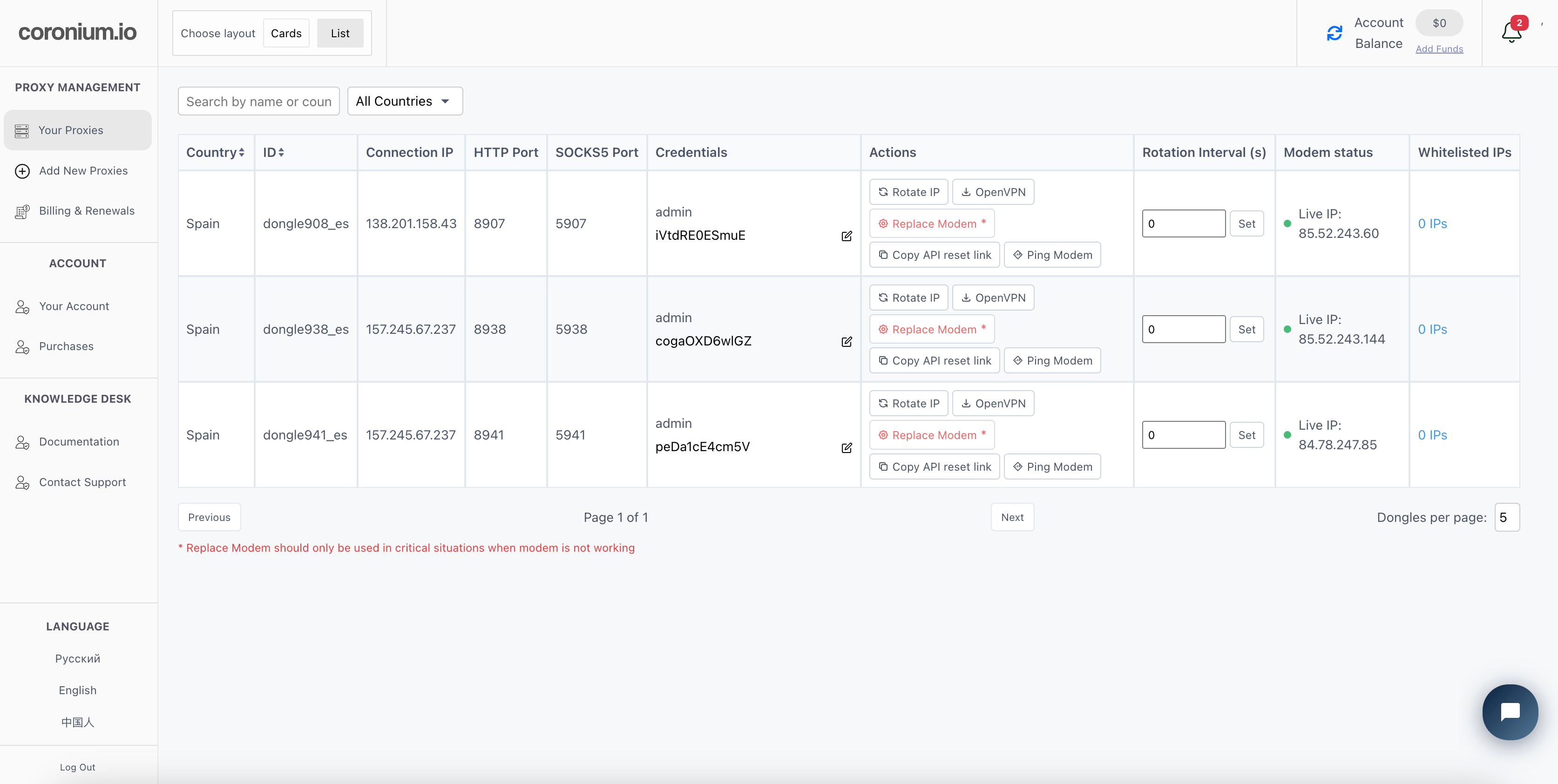
German Egress — Deployment Guide
Step-by-step: provision your first German device, select carrier and city, connect via HTTP/S or SOCKS5, and run your first agent session.
Related Proxy Solutions
Deploy German Egress
German 4G/5G Mobile Egress — Ready for Your Agent Fleet
Provision dedicated German mobile egress via REST in under 60 seconds. Carrier IPs from Deutsche Telekom, Vodafone, and O2 — with sticky sessions up to 24 hours, on-demand rotation, and OpenTelemetry-compatible usage metrics. Works with Playwright, browser-use, the Anthropic Agent SDK, and any scraping fleet that needs stable, geolocated egress from Germany.
ProxyStyler German mobile egress is intended for legitimate engineering and research purposes. Users are responsible for compliance with applicable law in Germany and the EU, including GDPR and the Bundesdatenschutzgesetz (BDSG). ProxyStyler does not support illegal use of the service.